Every loan application in India goes through a strict eligibility check, and your debt-to-income (DTI) ratio sits right at the centre of that assessment. Whether you are planning to apply for a home loan or a business loan for your company , understanding your DTI ratio can make the difference between approval and rejection.
In this guide, we break down the DTI ratio meaning, the formula banks use, the ideal benchmarks lenders follow in India, and practical steps you can take to bring your ratio into a lender-friendly range.
How Is the Debt-to-Income Ratio Calculated?
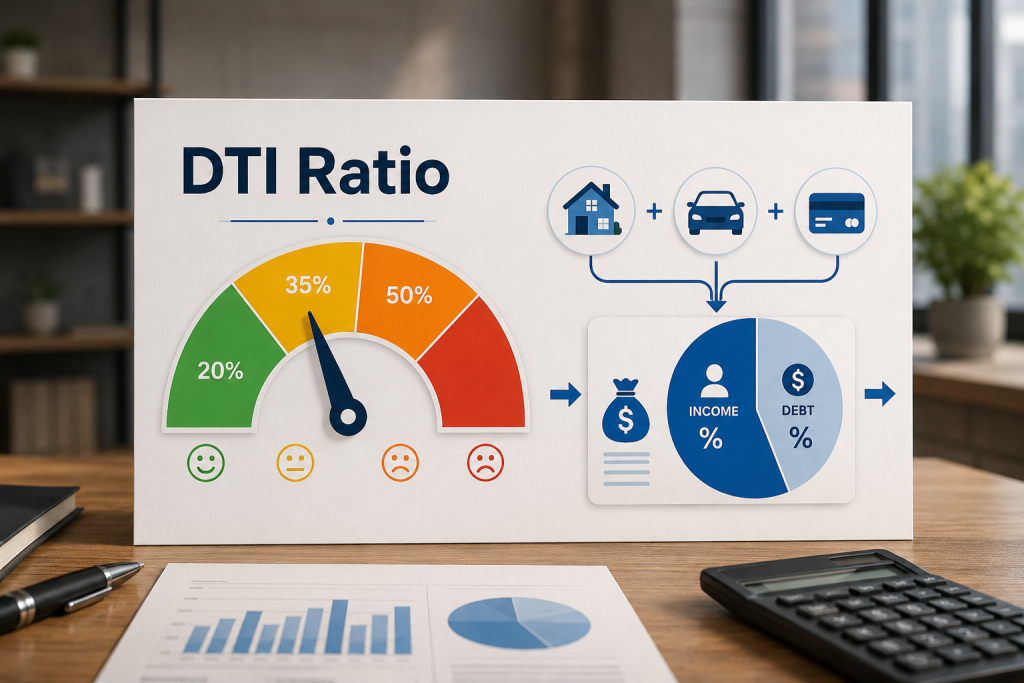
The debt-to-income ratio is a simple percentage that compares your total monthly debt obligations against your gross monthly income. Banks and NBFCs in India use this number to evaluate how much of your earnings are already committed to existing debts.
DTI Formula:
DTI Ratio (%) = (Total Monthly Debt Payments ÷ Gross Monthly Income) × 100
Example Calculation:
| Component | Amount (₹) |
|---|---|
| Monthly Salary (Gross) | 1,00,000 |
| Home Loan EMI | 25,000 |
| Car Loan EMI | 10,000 |
| Credit Card Minimum Payment | 5,000 |
| Total Monthly Debt | 40,000 |
| DTI Ratio | 40% |
In this example, 40% of the borrower’s gross income goes toward servicing debt. Most Indian banks consider this the upper boundary for loan approval.
Why Do Banks and NBFCs Check Your DTI Ratio?
Lenders assess DTI to measure repayment risk. A borrower whose income is largely consumed by existing EMIs has less room to take on fresh debt. Here is why DTI matters at every stage of lending:
- Risk Assessment: A high DTI signals that the borrower may struggle with additional EMIs during financial stress such as a job loss or medical emergency.
- Loan Amount Calculation: Banks use DTI to decide the maximum loan amount they can safely disburse. A lower DTI means you qualify for a higher sanctioned amount.
- Interest Rate Determination: Applicants with a low DTI often receive preferential interest rates because they represent lower default risk.
- Regulatory Compliance: RBI guidelines encourage responsible lending. Banks must ensure borrowers are not over-leveraged before granting credit.
Understanding your credit score alongside your DTI gives you a full picture of how banks evaluate your profile.
Ideal Debt-to-Income Ratio for Different Loan Types in India
| Loan Type | Ideal DTI Range | Maximum DTI Accepted |
|---|---|---|
| Home Loan | 30%-40% | 50% (with strong profile) |
| Personal Loan | Below 35% | 40%-45% |
| Business Loan | Below 40% | 50% (with collateral) |
| Car Loan | Below 30% | 40% |
| Loan Against Property | 35%-45% | 55% (secured) |
| Education Loan | Below 30% | 40% |
Key Takeaway: Keeping your DTI below 36% places you in the “safe zone” for most lenders. Anything above 50% significantly reduces your approval chances across all loan products.
DTI Ratio Benchmarks: Where Do You Stand?
| DTI Range | Risk Level | Loan Approval Likelihood |
|---|---|---|
| Below 20% | Excellent | Very High – Premium rates available |
| 20%–35% | Good | High – Smooth approval process |
| 36%–43% | Moderate | Moderate – Additional docs may be needed |
| 44%–50% | High | Low – Limited options, higher rates |
| Above 50% | Very High | Very Low – Most lenders will decline |
What Debts Are Included in the DTI Calculation?
Banks in India consider the following obligations when calculating your DTI:
Included in DTI:
- Home loan EMIs
- Personal loan EMIs
- Car or vehicle loan EMIs
- Credit card minimum payments
- Education loan EMIs
- Business loan EMIs
- Any other active EMIs or loan obligations
Not Included in DTI:
- Rent payments
- Utility bills (electricity, water, internet)
- Grocery and daily living expenses
- Insurance premiums
- SIP or investment commitments
7 Proven Ways to Improve Your Debt-to-Income Ratio
1. Pay Off Small Debts First
Close outstanding credit card balances and small personal loans. Even clearing a ₹5,000 monthly EMI reduces your DTI meaningfully.
2. Increase Your Income
A side income, freelance work, or rental income can boost your gross monthly earnings. Higher income directly lowers your DTI percentage.
3. Avoid Taking New Debt
Hold off on new credit cards or buy-now-pay-later plans for at least 6 months before a major loan application.
4. Consolidate Multiple Loans
If you have several EMIs running, a debt consolidation through a loan against property can merge them into a single lower EMI, reducing your overall monthly obligation.
5. Negotiate Lower Interest Rates
Request your existing lenders to lower your interest rates. Even a 0.5% reduction can bring your EMI – and DTI – down.
6. Extend Loan Tenure
Longer tenure means lower monthly EMIs. While you pay more interest over time, it brings your DTI within the acceptable range for a new loan.
7. Add a Co-Applicant
Adding a working spouse or family member as a co-applicant on your home loan combines both incomes, effectively lowering the DTI ratio.
How Indian Banks Verify Your DTI During Loan Processing
- Income Verification: Banks check salary slips, ITR filings, Form 16, and bank statements to confirm your gross monthly income.
- Credit Bureau Report: A CIBIL or Experian report is pulled to identify all active loans, credit cards, and their outstanding balances.
- EMI Obligation Mapping: Each active loan’s monthly EMI is listed. Banks also factor in the proposed new loan’s EMI.
- DTI Calculation: Total EMIs (existing + proposed) are divided by verified gross income.
- Decision: If the DTI falls within the acceptable range, the application proceeds. If it exceeds limits, the bank may reduce the loan amount, ask for collateral, or reject.
DTI Ratio vs. FOIR: Understanding the Difference
Indian lenders often use another metric called FOIR (Fixed Obligation to Income Ratio) alongside DTI. While they sound similar, there is a subtle difference:
| Parameter | DTI Ratio | FOIR |
|---|---|---|
| Full Form | Debt-to-Income Ratio | Fixed Obligation to Income Ratio |
| Includes | All debt payments | All fixed obligations (incl. rent, insurance) |
| Used By | Global standard | Primarily Indian banks and NBFCs |
| Ideal Range | Below 36% | Below 40%–50% |
Most Indian banks internally use FOIR but communicate it as DTI to borrowers. The calculation methodology remains similar.
Frequently Asked Questions
-
How does a high DTI ratio affect my loan EMI and tenure options?
A high DTI limits your eligible loan amount. Banks may offer a smaller loan with a longer tenure to keep the EMI manageable within your income.
-
Can I get a home loan in India with a DTI ratio above 50%?
It is extremely difficult. Most banks cap home loan approvals at 50% DTI. You may need to add a co-applicant or reduce existing debts first.
-
Does my spouse’s income count when calculating the DTI ratio?
Yes, if your spouse is a co-applicant on the loan. Both incomes are combined, which effectively lowers the DTI percentage.
-
How quickly can I improve my debt-to-income ratio before applying?
Paying off one or two small loans can improve your DTI within 30-60 days. Increasing income or adding a co-applicant also works immediately.
-
Do banks in India check DTI for credit card applications?
Yes. Banks assess your overall debt obligations even for credit cards, though the DTI threshold is usually more relaxed (up to 50-60%).
-
Is DTI ratio more important than CIBIL score for loan approval?
Both carry equal weight. A strong CIBIL score (750+) with a high DTI may still get declined. Banks need both metrics in the acceptable range.
-
How does prepaying an existing loan help my DTI ratio?
Prepayment reduces or eliminates that loan’s EMI from your monthly obligations, directly bringing down your DTI percentage
-
Can business owners calculate DTI differently than salaried individuals?
Yes. Self-employed individuals use net business profit (from ITR) as their income. Banks may also consider average income over 2–3 years.
-
Does the DTI ratio change if interest rates increase on my existing loans?
Absolutely. A rate hike on floating-rate loans increases your EMI, which in turn raises your DTI. Monitor your loans regularly after rate changes.
-
Should I close a credit card to lower my DTI ratio before a loan application?
Closing the card removes its minimum payment from DTI. However, ensure it does not negatively impact your credit utilisation ratio and CIBIL score.
H2: Conclusion
Your debt-to-income ratio is one of the most critical numbers banks evaluate before sanctioning any loan in India. Keeping it below 36% puts you in a strong position for quick approvals, better interest rates, and higher loan amounts. By proactively managing your existing debts, increasing your income streams, and planning your loan applications strategically, you can ensure that your DTI always works in your favour.
Need expert guidance on improving your loan eligibility? Contact Nihal Fintech today – our consultants will review your financial profile and help you secure the best loan terms from India’s top banks and NBFCs.
Disclaimer: The information provided in this article is for general educational and informational purposes only and should not be considered financial, legal, or professional advice. Loan approval criteria, debt-to-income ratio limits, and lending policies may vary between banks and NBFCs in India.