A Mumbai business owner once asked us a simple question.”I need ₹15 lakh. Should I take a term loan or a working capital loan?” The honest answer: it depends on what the money needs to do, not just how much you need.
Most business owners get stuck here. They ask, “Which loan is cheaper?” or “Which loan is faster?” The real question is “which loan matches the job.” Buy new machinery, and a term loan usually fits.Pay next month’s supplier bill during a slow season, and a working capital loan usually fits. Mix the two up, and problems follow. You could end up repaying a long-term investment on a short-term clock. Or you tie up short-term credit in an asset that won’t pay for itself for years.
This guide explains the difference between a term loan and a working capital loan in plain language. It shows which situations call for which loan, and points out the one mistake that trips up even experienced business owners.
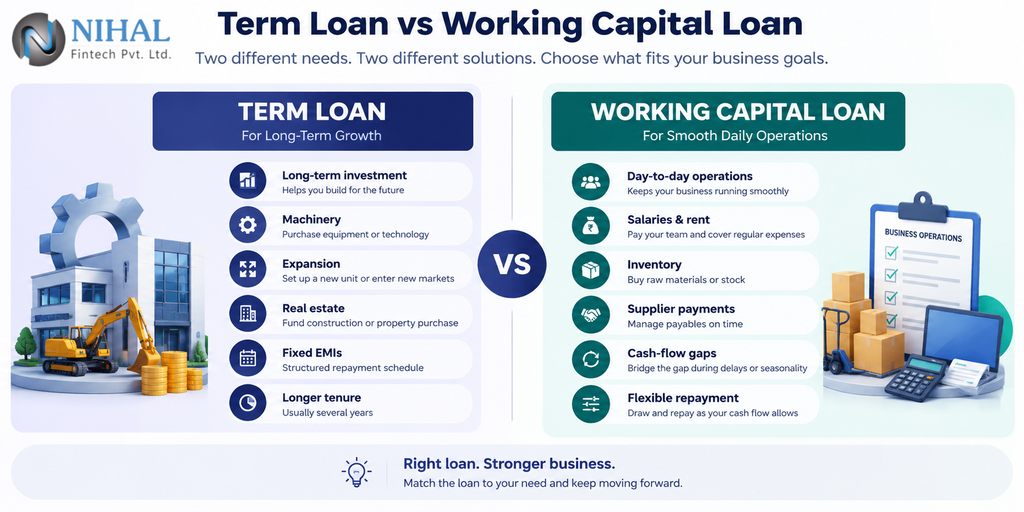
Key Difference Between Term Loan and Working Capital Loan, in One Line
Here is the short version. A term loan is money borrowed for a fixed period. It funds something that builds long-term value: machinery, expansion, a new unit, or a big one-time purchase. A working capital loan is money borrowed to keep the day-to-day engine of your business running. It covers salary payouts, rent, inventory, and supplier payments. It matters most when cash coming in doesn’t line up with cash going out.
Both are common forms of business financing. They serve different purposes, and each type of loan is designed around a different repayment expectation. Loans solve different problems. One funds growth, such as long-term investments like new machinery. The other protects daily cash flow, covering short-term needs like payroll. The confusion is not about which loan is better. It’s about which one matches your business needs right now.
Working Capital Loan vs Term Loan: What Each One Is Built For
Term Loan: What It Actually Funds
A term loan is disbursed as a lump sum. You repay it over a fixed tenure through structured EMIs (equated monthly instalments). This business term loan structure works best when the money funds something that keeps generating value long after the loan closes.
Typical uses of a term loan include:
- Buying machinery or equipment
- Setting up a new office, unit, or facility
- Funding a real estate or construction project
- Business expansion into a new city or segment
- One-time capital expenditures
Because the loan amount is often higher and the tenure longer sometimes running several years lenders usually ask for collateral or an asset-backed guarantee. They also look closely at the borrower’s business stability, credit history, and past financials. This is one reason a term loan involves more paperwork than a short-term loan. Long-term loans of this type work on fixed repayment schedules. Business owners should understand the difference between working with predictable EMIs and more flexible short-term facilities before they sign. If you’re planning a large-scale expansion, apply for a business loan built for growth-stage funding. Its repayment structure is designed exactly for that purpose.
Working Capital Loan: What It Actually Funds
A working capital loan closes the gap between when money leaves your business and when it comes back in. It doesn’t fund a new asset. It keeps operations moving when receivables are delayed, demand is seasonal, or a big order needs upfront spending before payment arrives.
Typical uses of a working capital loan include:
- Paying staff salaries and rent on time
- Buying raw materials or inventory
- Managing supplier payments during a cash crunch
- Bridging the gap during receivable delays
- Covering short-term, recurring operational costs
A working capital loan usually comes with shorter repayment periods, quicker approval, and more flexible repayment. Some working capital facilities are structured as revolving credit or cash credit. You draw the funds down and repay them as your cash flow allows. If your business deals with seasonal demand or long receivable cycles, check your working capital loan eligibility. This facility is built to absorb exactly that pressure.
Working Capital Loan Vs Term Loan: Quick Comparison Table
| Factor | Term Loan | Working Capital Loan |
|---|---|---|
| Purpose | Long-term investment, asset creation, expansion | Short-term operational needs, day-to-day expenses |
| Tenure | Longer – often one to several years | Shorter – typically a few months to about a year |
| Repayment | Fixed EMIs on a set schedule | Flexible; some structured as revolving credit |
| Collateral | Usually required | May or may not require collateral, depending on amount |
| Approval Process | More documentation, longer processing | Faster and simpler in most cases |
| Loan Amount | Typically higher | Typically smaller, tied to operational scale |
| Interest Rate | Often carries a lower interest rate given longer tenure and collateral backing | Can carry a higher interest rate given shorter, less predictable repayment |
| Best Suited For | Machinery, expansion, real estate, capital expenditure | Salary, inventory, supplier payments, cash flow gaps |
This table captures the surface-level difference between a working capital loan and a term loan. The real decision comes down to matching the loan to your actual situation. The next section covers that.
Match the Loan to the Situation, Not the Loan Name
Instead of memorising definitions, think in terms of real business situations. Here’s how the choice usually plays out.
Situation 1: You’re buying new machinery to increase production capacity.
This is a long-term investment. It pays off over years, not weeks. Use a term loan here. Its fixed EMI structure matches this return timeline far better than a short-term credit line would.
Situation 2: Your biggest client always pays 60 days late, and payroll is due next week.
This is a cash flow timing problem, not an investment decision. A working capital loan bridges that gap. It avoids forcing you into a multi-year commitment for a temporary shortfall.
Situation 3: Festive season is coming, and you need extra inventory before the demand spike.
This need is short-term and recurring. It resolves itself once the season’s sales come in. That’s a textbook working capital situation.
Situation 4: You’re a growing business without heavy collateral, and you need flexible funding across operations and small growth investments.
When the need doesn’t fit neatly into “clearly long-term” or “clearly short-term,” an unsecured business loan can offer flexibility. It skips the heavy collateral load a traditional term loan usually demands.
The Mistake Businesses Keep Making
The most expensive mistake: using a working capital loan to fund a long-term investment. It looks like a shortcut. Working capital loans are faster to get and need less paperwork. But a short repayment period on a loan meant for a multi-year asset creates a problem. Repayment pressure builds long before that asset generates enough returns to cover it.
The reverse mistake happens too. Businesses lock themselves into a long-tenure term loan for a purely short-term, one-time cash gap. This means paying interest over years for a problem that resolved itself in weeks. It often comes with collateral commitments that weren’t necessary in the first place.
The fix: match the loan’s repayment timeline to how long the underlying need takes to pay for itself.
Can a Business Use Both Loans at the Same Time?
Yes. Many established businesses run a term loan for a specific expansion project alongside a working capital facility that handles regular operations. For example, a business undertaking a large project funding initiative for a new facility might use structured, long-tenure financing for the project itself. A separate working capital line continues to manage everyday expenses, so project financing doesn’t get diverted into salary payouts or supplier payments.
Structured correctly, using both loan types protects cash flow instead of straining it. Each loan does the job it was designed for.
Quick Checklist: How to Decide Between These Loan Options
Before choosing between a term loan and a working capital loan, ask:
- Will this expense generate value over years, or resolve itself in weeks or months?
- Do I need a lump sum for one purchase, or ongoing access to funds?
- Can I offer collateral, or do I need a lighter-documentation option instead?
- Is this a recurring, cyclical need, seasonal demand, receivable delays – or a one-time investment?
- How comfortable am I with a longer repayment period versus a shorter, more flexible one?
Your answers point you toward the right loan type. If more than one answer overlaps – part investment, part operational cushion treat that as a sign. You likely need a blended approach, not one loan type stretched to cover everything.
RBI Guidelines for MSME Loans
The Reserve Bank of India’s FAQs on MSME lending confirm that bank loans to MSMEs qualify for priority sector lending classification, covering both working capital and term loan products used for production and investment needs. Neither loan type is inherently better. Each is built for a specific purpose, and the RBI’s own framework treats them as distinct categories of business credit.
Choosing between them isn’t a paperwork decision alone. It directly affects your cash flow, your growth timeline, and how much interest you pay overall. If you prefer watching over reading, this HDFC Bank explainer on term loans versus working capital loans covers the basics well. Speaking with a lending partner who assesses your business situation makes the decision far easier than picking a one-size-fits-all product.
Frequently Asked Question
-
Can I convert a working capital loan into a term loan later?
Generally, no. The two loan types are structured differently from the start. If your need shifts from short-term to long-term, apply for a fresh term loan instead. Don’t stretch a working capital facility beyond its intended purpose.
-
Which loan has a lower interest rate term loan or working capital loan?
This varies by lender, loan amount, and collateral offered. As a general pattern, a term loan with collateral backing often carries a lower interest rate. A working capital loan with lighter documentation may carry a higher interest rate instead. This isn’t a fixed rule across every lender.
-
Do I need collateral for a working capital loan?
Not always. Depending on the loan amount and your business profile, a working capital loan can be secured or unsecured. A term loan more often requires collateral, given its higher amount and longer repayment period.
-
What is the biggest difference between a term loan and a working capital loan?
The core difference lies in purpose and repayment structure. A term loan funds long-term investments through fixed EMIs. A working capital loan funds short-term operational needs through faster, more flexible repayment.
-
Can a small business apply for both a term loan and a working capital loan together?
Yes. Many small and growing businesses use both loan options at once: a term loan for a specific expansion or asset purchase, and a working capital facility to keep daily operations running alongside it.
-
Does my credit score affect approval differently for each loan type?
Yes, to some extent. Since a term loan usually involves a higher amount and longer tenure, lenders weigh the borrower’s credit history and repayment track record more heavily. For a working capital loan, especially smaller ones, lenders may weigh recent cash flow and transaction patterns more than credit history alone.
Conclusion
A term loan and a working capital loan solve two different problems, not two versions of the same problem. Use a term loan when the money builds something that pays off over years, like machinery or expansion. Use a working capital loan when the money keeps daily operations running through a short-term cash gap. Get this match right, and both your repayment pressure and your growth plans stay on track.
Ready to figure out which loan structure fits your business? Talk to a Nihal Fintech loan expert for guidance tailored to your actual cash flow and growth plans.