Every business from a small MSME in Pune to a large manufacturer in Mumbai depends on how efficiently cash flows through its operations. The working capital cycle is the engine that drives this cash flow, and when it stalls, growth stalls with it. Understanding and optimising your working capital financing is not just a finance team’s job – it directly impacts whether your business can scale, hire, and compete.
This guide explains the working capital cycle in practical terms, breaks down the formula with real Indian business examples, and gives you actionable strategies to shorten your cycle and unlock faster growth.
Understanding the Working Capital Cycle
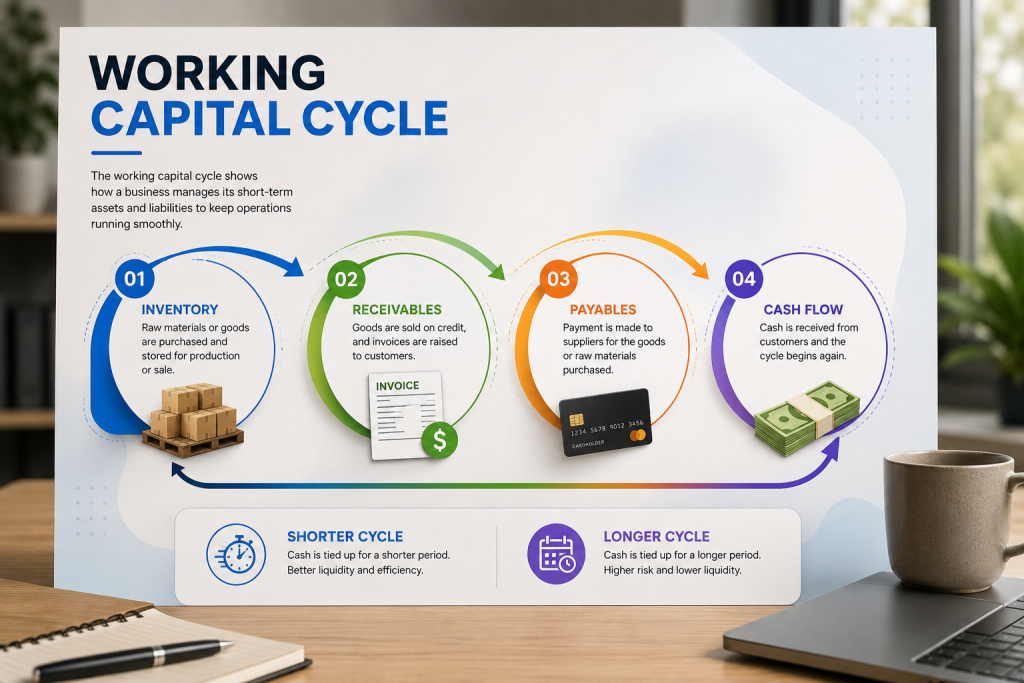
The working capital cycle (also called the cash conversion cycle) measures the number of days your business takes to convert its net current assets – inventory and receivables into actual cash, after accounting for the time you take to pay your suppliers.
In simple terms: it tells you how long your money is “stuck” in business operations before it comes back as cash in your bank account.
A shorter cycle means:
- Cash returns faster to reinvest in operations
- Less dependency on external borrowing
- Stronger negotiating position with suppliers and customers
A longer cycle means:
- Cash is tied up in inventory or unpaid invoices
- Greater need for working capital loans or credit lines to bridge gaps
- Higher interest costs eating into profits
The Working Capital Cycle Formula
The formula comprises three components that together paint a complete picture of your cash flow timing:
Working Capital Cycle = DIO + DSO – DPO
| Component | Full Form | Measures |
|---|---|---|
| DIO | Days Inventory Outstanding | How many days inventory sits before being sold |
| DSO | Days Sales Outstanding | How many days to collect payment after a sale |
| DPO | Days Payable Outstanding | How many days you take to pay your suppliers |
How to Calculate Each Component
1.Days Inventory Outstanding (DIO):
DIO = (Average Inventory ÷ Cost of Goods Sold) × 365
2.Days Sales Outstanding (DSO):
DSO = (Average Accounts Receivable ÷ Net Credit Sales) × 365
3.Days Payable Outstanding (DPO):
DPO = (Average Accounts Payable ÷ Cost of Goods Sold) × 365
Real-World Example: Indian MSME Calculation
| Metric | Value |
|---|---|
| Average Inventory | ₹15,00,000 |
| COGS (Annual) | ₹60,00,000 |
| Average Accounts Receivable | ₹12,00,000 |
| Net Credit Sales (Annual) | ₹72,00,000 |
| Average Accounts Payable | ₹10,00,000 |
| DIO | (15,00,000 ÷ 60,00,000) × 365 = 91 days |
| DSO | (12,00,000 ÷ 72,00,000) × 365 = 61 days |
| DPO | (10,00,000 ÷ 60,00,000) × 365 = 61 days |
| Working Capital Cycle | 91 + 61 – 61 = 91 days |
This means the business’s cash is locked for 91 days from the time it purchases raw materials until it collects payment from customers. For a growing MSME seeking business expansion funding, reducing this cycle by even 15-20 days can free up lakhs in working capital.
The Three Stages of the Working Capital Cycle
Stage 1: Inventory Phase (DIO)
This is the period from purchasing raw materials to selling the finished product. For manufacturing businesses in India, this phase often takes the longest.
Factors that increase DIO:
- Overstocking due to inaccurate demand forecasting
- Slow-moving inventory or obsolete products
- Seasonal demand fluctuations (common in textile, agriculture, and FMCG sectors)
- Long production cycles
Stage 2: Receivables Phase (DSO)
Once goods are sold, DSO measures how long customers take to pay. In India, B2B businesses frequently operate on 30–90 day credit terms, stretching this phase significantly.
Factors that increase DSO:
- Lenient credit policies without proper verification
- Delayed invoicing
- Customers negotiating extended payment terms
- Lack of systematic follow-up on overdue payments
Stage 3: Payables Phase (DPO)
DPO represents the time you take to pay your suppliers. A higher DPO works in your favour as it means you are holding onto your cash longer.
Factors that increase DPO:
- Negotiated extended supplier credit terms
- Volume-based payment agreements
- Supplier financing arrangements
How the Working Capital Cycle Directly Impacts Business Growth
| Cycle Length | Impact on Business |
|---|---|
| Short (under 30 days) | Rapid reinvestment, strong cash reserves, easy access to growth capital |
| Moderate (30-60 days) | Manageable with good planning, occasional short-term borrowing |
| Long (60-90 days) | Cash crunches during peak demand, frequent reliance on working capital loans |
| Very Long (90+ days) | Growth stagnation, difficulty paying suppliers, loan dependency increases |
The Growth-Killing Chain Reaction of a Long Cycle
- Cash Crunch → Missed Opportunities: When cash is locked in inventory and receivables, you cannot take on large orders or invest in new equipment.
- Borrowing Dependency → Profit Erosion: Relying on term loans or overdraft facilities to cover daily operations eats into margins through interest costs.
- Supplier Strain → Supply Chain Risk: Delaying supplier payments to manage cash flow can damage relationships, lead to credit term reductions, or cause supply disruptions.
- Slow Scaling → Competitive Disadvantage: Competitors with shorter cycles reinvest faster, launch products sooner, and capture market share.
8 Strategies to Shorten Your Working Capital Cycle
Reduce DIO (Sell Inventory Faster)
1. Implement Just-in-Time (JIT) Inventory Management
Order raw materials based on actual demand rather than forecasts. Indian MSMEs adopting JIT have reported 20–30% reduction in inventory holding costs.
2. Conduct Regular ABC Analysis
Categorise inventory by value and turnover:
• A-items (high value): Tight control, frequent review
• B-items (moderate): Regular monitoring
• C-items (low value): Minimal oversight, bulk ordering
3. Liquidate Slow-Moving Stock
Run clearance sales, offer bundle deals, or sell on B2B marketplace platforms to free up cash from dead inventory.
Reduce DSO (Collect Payments Faster)
4. Automate Invoicing and Payment Reminders
Digital invoicing tools reduce manual errors and send automatic reminders. Businesses using automated billing report 25–30% faster collections.
5. Offer Early Payment Incentives
A 2% discount for payment within 10 days (2/10 Net 30) motivates customers to pay earlier, improving your cash inflow.
6. Tighten Credit Policies
Verify customer creditworthiness using CIBIL scores before extending credit. Set clear terms 30 or 45 days maximum and enforce them consistently.
Increase DPO (Manage Outflows Smartly)
7. Negotiate Extended Payment Terms with Suppliers
Leverage your purchase volume to negotiate 60 or 90-day payment terms instead of 30 days. This keeps cash in your business longer.
8. Use Supplier Financing Programmes
Many Indian banks offer supply chain finance products where the bank pays your supplier upfront and you repay the bank on extended terms.
Working Capital Cycle Benchmarks by Industry in India
| Industry | Avg DIO | Avg DSO | Avg DPO | Typical Cycle |
|---|---|---|---|---|
| FMCG | 25–35 days | 20–30 days | 40–50 days | 5–15 days |
| Manufacturing | 60–90 days | 45–60 days | 30–45 days | 75–105 days |
| IT Services | 0–5 days | 50–70 days | 25–35 days | 25–40 days |
| Retail (Offline) | 30–45 days | 5–10 days | 30–40 days | 5–15 days |
| Construction | 90–120 days | 60–90 days | 45–60 days | 105–150 days |
| Textile | 60–80 days | 40–60 days | 30–45 days | 70–95 days |
Use these benchmarks to compare your business’s cycle and identify which component needs the most improvement.
Frequently Asked Questions
-
How often should a business review its working capital cycle?
Monthly reviews are ideal. Track DIO, DSO, and DPO each month to spot trends early and take corrective action before cash flow problems escalate.
-
Can a negative working capital cycle be good for business?
Yes. A negative cycle means you collect from customers before paying suppliers. Companies like Amazon and large retailers operate this way, giving them strong cash positions.
-
How does seasonal demand affect the working capital cycle for Indian MSMEs?
Seasonal spikes increase inventory (higher DIO) while customers may demand credit (higher DSO), stretching the cycle. Pre-season planning and short-term financing help bridge the gap.
-
Does GST compliance impact the working capital cycle in India?
Yes. GST refund delays can lock up working capital for 60–90 days. Businesses should factor in refund timelines and maintain buffer cash for tax periods.
-
How do rising interest rates change working capital management strategies?
Higher rates make borrowing costlier, making cycle optimisation critical. Focus shifts to reducing DIO and DSO rather than relying on credit lines.
-
Can technology tools help reduce the working capital cycle for small businesses?
Absolutely. Cloud-based ERP, automated invoicing, inventory management software, and UPI-based collections can reduce the cycle by 20–40% for SMEs.
-
Is the working capital cycle different for service-based vs. product-based businesses?
Yes. Service businesses have minimal DIO (no physical inventory), so their cycle is driven almost entirely by DSO and DPO. Product businesses face all three components.
-
How does export business impact the working capital cycle?
Export adds complexity through longer shipping times, customs delays, and foreign buyer payment terms (often 60–90 days). Export credit facilities from banks help manage this.
-
Should a startup focus on working capital cycle management from day one?
Absolutely. Startups burning cash need tight cycle management. Many startups fail not from lack of demand but from running out of working capital before collecting revenue.
-
How does the working capital cycle affect a company’s loan eligibility?
Banks review your cycle as part of loan appraisal. A shorter, well-managed cycle signals financial discipline and increases your eligibility for higher loan amounts at better rates.
Conclusion
The working capital cycle is not just a financial metric – it is the heartbeat of your business operations. A well-managed cycle frees up cash for expansion, reduces your dependence on external borrowing, and gives you the agility to seize market opportunities ahead of competitors. Whether you are running a manufacturing unit, a trading business, or a service company, regularly monitoring and optimising your DIO, DSO, and DPO is essential for sustainable growth.
If your business needs financing to optimise operations or bridge working capital gaps, contact Nihal Fintech for expert consultation. Our team works with India’s leading banks and NBFCs to secure the right funding solution for your business needs.
Disclaimer: The information provided in this article is for educational and informational purposes only and should not be considered financial, legal, or investment advice. Working capital requirements and cash flow cycles vary by business type, industry, and market conditions. Businesses should evaluate their specific financial circumstances and consult qualified financial advisors or lenders before making financing or cash flow management decisions. Loan approval and funding terms are subject to lender eligibility criteria and applicable regulations.